Accessoires IBC 1000 litres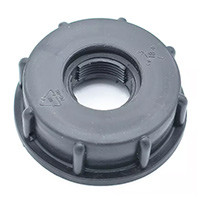
 Couvertures Chauffantes
 Raccords Plomberie
 Bidons / Futs et raccords
 Semences

 Produits Phyto

 Jardin


 Espaces Verts

 Barbecue - Braséro - Cheminée

 Entretien

 Fluides & Climatisation
 Arrosage
Gravity Irrigation on 1000L Tank: Guide and Assembly
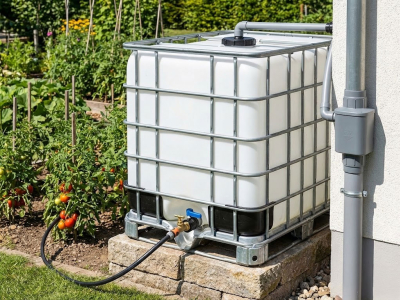
Spring 2026 is just around the corner, and with it comes the awakening of the vegetable garden. But storing water in a 1000-litre tank is only the first step to success. The real challenge for the modern gardener is to distribute this precious resource to the plant roots, effortlessly and above all, without waste. Gravity irrigation on IBC (Intermediate Bulk Container) is the most ecological and autonomous solution. By simply using the natural pressure of the water column, you can feed your garden without electricity, without pump noise and with millimetric precision. At Multitanks, we can help you design your low-pressure drip system.
Understanding the physics of gravity (low pressure)
The secret of successful tank irrigation IBC lies in a simple but often misunderstood physical concept: hydrostatic pressure. For every metre of difference in height between the water level in your tank and your crops, you gain around 0.1 bar of pressure. If your tank is on the ground, the pressure will be almost zero, making watering very slow and inefficient.
Optimization therefore starts with raising the height of your tank. By placing your tank on a solid support (cinder block, low wall or reinforced wooden structure) at a height of 50 cm to 1 metre, you create a sufficient load to supply a drip system. This is known as "low-pressure" watering. Unlike the city network, which reaches 3 or 4 bar, your gravity-fed system will oscillate between 0.05 and 0.2 bar. This gentleness is a boon for plants, as it prevents soil compaction and allows slow, deep absorption.
The network foundation: S60x6 fittings
To transform an industrial tank into a watering distributor, you first need to tame its outlet. The world standard for 1000-litre tanks IBC is the S60x6 thread (60mm outside diameter with a 6mm wide thread pitch). This is where it all begins.
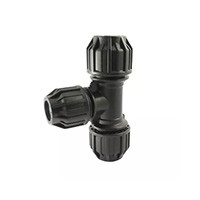
Using makeshift solutions or unsuitable adapters guarantees repeated leaks and a fatal loss of watertightness. It's essential to use high-density polypropylene (HDPE) molded parts filled with fiberglass to resist UV and frost. Our complete range of S60x6 fittings is the essential basis for securing your tank valve outlet and getting your distribution network up and running professionally.
Enemy n°1 of drip systems: impurities
The biggest risk to a gravity-fed system is clogging. As rainwater runs off your roof, it carries with it dust, tile debris, moss and bird droppings. In a high-pressure system, these particles can sometimes be expelled, but in a low-pressure system, they accumulate and end up clogging your gutters or porous pipes.
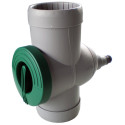
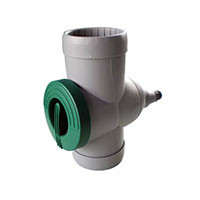
The solution lies not at the tap, but long before the water enters the tank. High-performance primary filtration is non-negotiable. To keep your water supply clean, we recommend installing a 3P Technik filter directly on your downspout. This ingenious system mechanically separates debris from clear water using a fine stainless steel screen. With water filtered at source, you're guaranteed a maintenance-free irrigation system all summer long.
Flow control: Precision valves and taps
Once the tank outlet has been adapted and the water filtered, you need to be able to control watering. The original valve on a IBC tank is a transport valve: it is not designed to be opened and closed daily, let alone to regulate a precise water flow. It must remain open at all times during the season, and you need to install a second level of control.
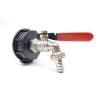
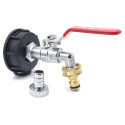
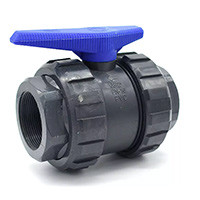
For robust manual control, a brass quarter-turn valve is ideal. It offers far greater mechanical strength than plastic for repeated handling. If you prefer a more compact, direct installation, our valves mounted on S60x6 fittings allow you to instantly connect a standard garden hose via a quick-fit coupling. This allows you to switch from manual watering to a fixed connection to your vegetable garden in just a few seconds.
Network design: from manifold to roots
In gravity irrigation, every bend and every meter of hose generates "pressure losses" (a reduction in pressure). To ensure that the water reaches the end of your row of tomatoes with the same intensity, you need to follow a golden rule: opt for a large-diameter main manifold (typically 16mm or 20mm PE) and avoid excessively winding routes.
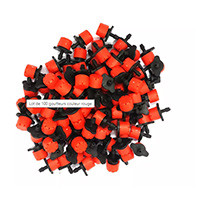
The classic set-up is to start from your tank tap with a quick-connect fitting, spread your main pipe out along your crops, and then spike drippers or micro-pipes directly onto this common trunk. In low-pressure conditions, the use of drip tape is particularly effective, as it has been designed to operate at very low pressures, where conventional self-regulating drippers would remain closed for lack of thrust.
Expert tip Multitanks: If you notice that water is not reaching the end of your line, don't try to install a pump. First check for air bubbles (purge the system) and try to divide your network into several smaller lines rather than one very long one. Gravity is patient, and prefers short paths!
Maintenance and longevity of your system
Installing your system in mid-March is an excellent strategy, as it gives you time to test the watertightness before the hot weather sets in. A good tank irrigation system can last more than 10 years if it's properly maintained. The main action is to purge the sediment accumulated at the bottom of the tank once a year, and to clean the strainer of your gutter collector.
As far as freezing is concerned, while your HDPE S60x6 fittings are extremely resistant, your brass valves and garden hoses are more fragile. Remember to leave the tank valve closed and the distribution valves open during the winter to prevent residual water from freezing and splitting the metal.
Conclusion
Collecting rainwater is a civic act; distributing it by gravity is an act of horticultural engineering. By combining the robustness of IBC tanks with the precision of S60x6 fittings and the reliability of downpipe filters, you create a self-sufficient, sustainable ecosystem. Not only do you protect the water table and your wallet, but you also provide your garden with gentle, regular watering based on nature's real needs. Take advantage of the month of March to lay the foundations for your future harvest, and don't forget: when it comes to irrigation, the simplicity of gravity is often more effective than the complexity of machinery.
How long will your rainwater reserve last this summer?
Share this content